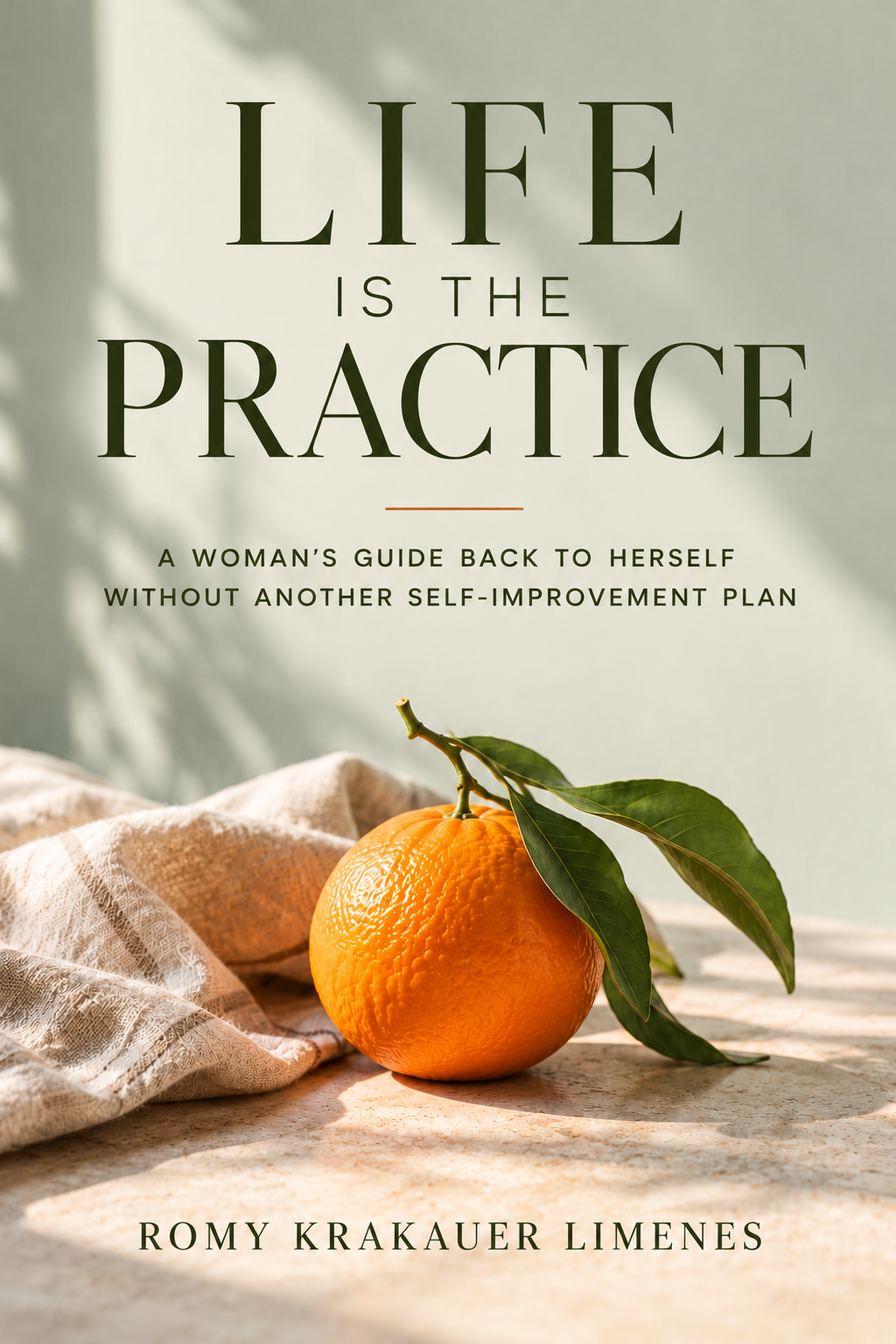
Life Is The Practice
For the woman
who senses
there must be more

Discover Why
So Many Women Feel Absent
From Their Own Lives, 
Even When Everything Looks Fine From The Outside

A practical guide to finding your way back into the life you're already living, one ordinary moment at a time.

We all know that sense of connection and aliveness we experience in a yoga class, on retreat, or when we step away from the demands of everyday life. But we shouldn't have to wait for the perfect place or moment to feel that way.

Through movement, breath, sound, and sensation, Life Is The Practice introduces a simple, embodied process for reconnecting with yourself and the moment you're actually in.

It's about really listening when someone you love is speaking, savoring a meal instead of rushing through it, noticing the beauty around you, and allowing yourself to feel what's here rather than pushing it away. It's also about recognizing familiar patterns, pausing before reacting out of habit, and choosing how you want to respond.

Because this is your one life. It's not waiting for you somewhere down the road, when things settle down or everything finally falls into place.

Life is happening right now. Are you ready to come back in?

Yes! Rush me a copy for $20
Ebook only · Instant download

The Life You're Living Is the One You're Missing

You can have a life and still feel absent from it.

You can be moving through a season of change, building a life that matters to you, or simply going about your everyday days—and still feel somewhat removed from your own experience. Life is happening, things are unfolding, but you don't always feel fully connected to what you're living.

Sometimes it's hard to put your finger on. Nothing is necessarily wrong. You're not unhappy, exactly. But there's a distance between going through the motions of your day and actually feeling yourself in it.

You might notice it in the way you move from one thing to the next, rarely pausing long enough to register what's happening. Or in how quickly your mind moves to what's coming, what needs attention, what you should have said, or what you need to do differently.

You can understand yourself quite well. You might even know exactly why you fall into certain patterns. But knowing something and being able to meet it differently while it's happening are two different things.

And somewhere in all of this, your own life can become the thing you keep getting to later.

Who are you while you're waiting?

The Perfect-Place Delusion

Most of us have an idea about when and where we'll finally feel more present in our own lives.

Maybe it's a place: the yoga class, the quiet room, the weekend away, the retreat, the walk without anyone needing anything from you.

Or maybe it's a time: when work settles down, when the children are older, when the divorce is behind you, when you feel better, when this particular season of life finally passes.

I call this the Perfect-Place Delusion. It takes two forms: the belief that connection happens somewhere else, and the belief that it will happen sometime later.

And I understand why we believe it. We really can feel different in those quieter spaces. A yoga class can help us feel more connected to our bodies. Time away can give us perspective. A few minutes of breathing can shift how we feel.

Those experiences matter. The trouble begins when we start to believe that connection belongs to those places and times alone.

Because then the rest of life becomes something to get through until we can return to them.

And the easier season we're waiting for keeps moving. One thing settles, another takes its place. The calendar fills up again. Life continues to happen, while we keep postponing our participation in it.

What if connection didn't require the perfect conditions? What if you could begin in the middle of an ordinary day, in the circumstances you're already living?

Not by making everything around you quiet, but by learning to notice what's happening within you and find a way to meet the moment you're in.

That's where this practice begins.

A Longing You Can't Quite Name

For a long time, I carried a feeling I couldn't quite put my finger on. It wasn't that I wanted a different life. In many ways, I had built the life I once imagined for myself. And yet, I still felt a longing for something more. I wanted to feel more of the life I was living.

I missed the way life used to feel when I was young, when the world seemed full of possibility. There was a sense of anticipation about what might happen next, a curiosity about what was around the corner. Ordinary things could feel exciting. I felt more open to the world, more easily moved by it, more alive to what was happening around me.

Somewhere along the way, that feeling had faded. My life looked perfectly good on paper, and I still found myself moving through it with a quiet sense of distance. As though I was just outside of it, looking in. I was there for the conversations, the experiences, the everyday moments, but I wasn't always really taking them in.

I didn't necessarily want more things, more accomplishments, or another version of the life I already had. I wanted to feel connected to it. To notice more. To be moved by the small things. To feel that sense of possibility again—not because everything was new, but because I was more available to what was already here.

I don't think I was looking for a different life. I was longing for a different experience of the one I had.

Four Doorways Into Your Experience

So how do you actually begin?

You begin with what's already available to you: your body, your breath, your voice, and your senses.

In Life Is The Practice, I introduce four simple doorways into the present moment: Bend, Breathe, Sound, and Feel.

They're not steps to follow or techniques you need to master. They're different ways to interrupt the automatic flow of your day, notice what's happening, and become more present to the moment you're in.

BEND

Move. Stretch. Sway. Shake. Let your body change position, find a little space, or express what words haven't quite captured. Sometimes a small movement can shift how you feel in a moment.

BREATHE

Your breath is always with you. You can notice it, follow it, soften it, or intentionally change its rhythm. A single conscious breath can create a little space between what's happening and how you respond.

SOUND

Hum. Sigh. Sing. Make a sound without needing it to mean anything or sound a particular way. Sound can help you express what's happening, release what you're holding, and feel vibration moving through your body.

FEEL

Notice sensation. Feel the ground beneath your feet, the temperature of the air, your heartbeat, or the touch of a hand resting on your chest. Notice how an emotion might show up as a sensation in your body. Rather than immediately trying to understand or explain what you're experiencing, begin by noticing what you can actually feel.

You don't need to use all four.
You don't need to do them in any particular order. Sometimes one doorway will feel accessible; another time, something completely different will call to you. Sometimes you will discover your own way.

Why I wrote this book

I didn't set out to become a somatic practitioner, a breathwork facilitator, or a coach. In fact, none of that was on my radar. I found my way to this work because life took me somewhere I never expected to go, and I needed to find my way through it.

I was already navigating a destabilizing period in my life. I was in the early stages of a divorce and had moved countries, trying to find my footing again. Just as things were beginning to settle, I was drugged and assaulted. When I woke up in a hospital with no memory and badly injured, I found myself being treated as the perpetrator rather than the person who had been harmed.

What followed was the unraveling of life as I knew it. After a long and excruciating legal process, I eventually surrendered the nursing license that had been central to my identity for more than twenty years. Along with my career went much of the professional community, belonging, and sense of purpose I'd built around it. The systems I had trusted and worked within seemed to have failed me, and some of the people I thought I could count on weren't there either. I found myself more alone, more stripped down, than I had ever been.

For so much of my adult life, I had been building toward something. I thought that if I worked hard enough, created enough stability, and got enough of the pieces in place, I would eventually feel settled and at home in myself. But when so much of what I'd built was suddenly gone, I came face to face with something I hadn't really understood before: I had never learned how to tend to the relationship with myself.

And I began to realize that the only way through, was in

Looking back, I can see that this pattern had been with me for a long time. Growing up, I had two homes and learned early to adapt to different environments and family dynamics. We didn't have much, and I was often aware of the ways that set me apart. Much of my childhood was spent imagining that my real life was waiting somewhere else, beyond the circumstances I was living in. I thought that once I left, built something, and became someone, I would finally get to be in my life.

So I did. I moved to the city, built a career I was proud of, married, and had my children. From the outside, I had created the life that little girl had been waiting for. And yet, I was still scanning every room for someone to tell me I was okay.

The furniture kept changing. The posture didn't.

As I began finding my way through this next chapter, I realized that understanding and insight alone weren't enough. I needed to meet in my body what I couldn't make sense of through words and analysis. I needed to feel safe in my body again, to learn how to sit with myself, meet what was present, and allow myself to feel what I was feeling. I didn't have a plan for how to do that. I just found myself instinctively reaching for movement, breath, and sound. I would move my body, breathe, make noise, and begin to notice what was happening inside me. My body seemed to be leading me somewhere before I had the language to understand where.

That eventually led me to breathwork, and then to deeper training in somatics and embodied practices. I began to understand why these experiences were helping me and why insight alone wasn't always enough. There was something about working through the body that allowed me to meet my experience differently, rather than simply think my way through it.

What began as a very personal search gradually became the foundation for the work I now share through Bend & Breathe.
 
And what I've come to understand is that coming back into contact with ourselves isn't about turning inward and staying there. It's about cultivating somewhere to return to, somewhere to regroup, reconnect, and draw from. It's how we build the foundation to meet our relationships, our choices, our challenges, and the world around us differently. We return so we can re-enter our lives with more of ourselves available.

That's the heart of Life Is The Practice. It grew out of my own experience of finding my way back, but it isn't about recreating my journey or following a particular path. It's an invitation to discover how you can work with the life you're already living, reconnect with yourself, and begin experiencing that life differently.

I didn't arrive at this work because I had figured life out. I arrived because I needed to find my way through it. And I'm still practicing.

The Anti-Practice: A Different Way To Be In Your Life

One of the things that first fascinated me about the breath was that it happens whether we're paying attention to it or not. Breathing is largely automatic, yet at any moment, we can bring our attention to it and begin to work with it. We can deepen it, slow it down, lengthen the exhale, or pause. And even these small shifts can have an immediate effect on how we feel in our bodies.

At some point, I began to realize that this same possibility exists in how we meet our lives.

You're already breathing. What happens when you bring some intention to your breath?

You're already walking. What happens when you begin to notice the weight of your body, the sensations beneath your feet, or experiment with changing your pace or movement?

You're already having conversations, making choices, experiencing emotions, and moving through your days. What becomes possible when you bring your attention to how you're meeting those moments?

Life is happening all the time. Much of the time, we move through it without really noticing how we're experiencing it. But just as we can bring attention and intention to the breath, we can bring them to any moment of our lives. We can pause, notice what's happening within us, and find a way to work with what we're experiencing. From there, we may discover a different way to meet the moment.

This is the foundation of what I call the Anti-Practice.

I call it the Anti-Practice because it isn't another thing to do, but a different way of experiencing what you're already doing.

It doesn't require setting aside more time or adding another thing to your list. You don't have to wait until the class begins, the house is quiet, or the weekend arrives. You can practice in the middle of making dinner, walking the dog, sitting in traffic, or having a difficult conversation.

The Anti-Practice works with the life that's already happening. It's about bringing your attention and intention into the moments you're living, and discovering how that can change your experience of them.

Yes! Rush me a copy for $20
Ebook only · Instant download

How It Works: Notice, Doorway, Stay, Name

The Anti-Practice isn't about getting it perfectly right. It's about noticing when your attention has moved away from the moment you're in, finding a way to reconnect with what's happening, and becoming more aware and intentional about how you're meeting your life in real time.

I think of this as four stages: Notice, Doorway, Stay, and Name.

01
Notice
Notice when you've lost contact with the moment you're in. It might show up as a physical sensation—a charge in your body, a knot in your stomach, pressure in your chest. It might be an emotion you can't quite name, a thought loop you can't seem to get out of, or your mind already rehearsing a conversation that hasn't happened yet.

Sometimes the noticing is simply: "Oh, there I went."

No judgment, no need to make anything wrong. Noticing is where the practice begins.
02
Doorway
Next, choose a way back into contact with yourself and the moment you're in. What might help you do that right now? Perhaps it's movement, a conscious breath, a sound, or simply noticing a physical sensation.

These are the four doorways introduced earlier: Bend, Breathe, Sound, and Feel.

There is no right choice. Begin with what feels accessible.
03
Stay
Give yourself a moment to stay with what you've found. Notice what's happening in your body, your thoughts, and your feelings. Rather than immediately trying to change, fix, or move past it, allow yourself to be with what's there.

You might need a little space, a shift in perspective, or simply the willingness to feel what's present.
04
Name
Give the experience a name. Maybe it was Breathe. Maybe it was Feel. Maybe it was something entirely different—a particular movement, a sound, a phrase, or a sensation that brought you into contact with what was happening. The name itself isn't important. What matters is recognizing what worked, so you can draw on it again when you need it.

With practice, you become more familiar with the things that help you reconnect with yourself and the moment you're in.

What Others Are Saying

"Romy coaches from a unique and personal lens, as opposed to a boilerplate template that may miss the mark for many students. My recommendation is to work with Romy as a coach if you want someone who listens, offers support, is able to zoom in and out as needed to get the work done, and can give great guidance."

— Bend & Breathe: your way client

"I feel deeply seen. And met without judgment."

—Renee, client

"You're kind, and you're also strong. It's like you know what I'm feeling before I have the words."

— joy, client

"I am certain as I navigate through my life and the various challenges that may arise I will be able to give far more testaments as to how much our time together has helped me. I am forever grateful for your help in creating new neuropathways in how to respond."

— Fey, client

Anna's Story: Finding Her Way Toward the Life She Wanted

Anna had spent decades caring for other people, beginning as the oldest child in a difficult home. She felt a pull toward the sea that she couldn't quite give herself permission to follow. Moving there would mean moving farther from her sons. Beneath that conflict was an old belief she'd carried for years: that being useful was what made her worth loving.

Over twelve weeks, we made room for the grief and uncertainty rather than trying to argue them away. Anna began to meet the inner judge she'd felt embarrassed by, not as something to silence, but as a protector that had been working hard for a very long time. She named her Lifelines and began bringing them into her everyday life.

"I feel my love for myself very strongly," she said. She chose to move toward the sea, and her relationship with her sons remained loving. Near the end of our work, she put it simply: "I'm more myself. I'm more fully rooted. I'm just feeling more like me."

Yes! Rush me a copy for $20
Ebook only · Instant download

What You'll Discover Inside

01
How to recognize when you're moving through life without really experiencing it
You'll learn to notice when your attention has wandered and find ways to re-engage with the moment you're living.
02
The difference between losing yourself and losing contact
Why you don't need to become someone else or find your way back to a former version of yourself. You can begin by changing how you meet the life you're living now.
03
How the Perfect-Place Delusion keeps you waiting
The belief that life will feel different somewhere else or sometime later—and how to recognize when you're postponing your experience of the life you're living now.
04
Why understanding your patterns doesn't necessarily change how you meet them
Insight helps you understand your patterns. The Anti-Practice helps you recognize what's happening as it's unfolding and work with it in the moment.
05
Four ways to work with the moment you're in
Bend, Breathe, Sound, and Feel. Explore ways to bring awareness and intention to what you're already doing, from a subtle shift at your desk to a full-bodied expression in your kitchen.
06
How to stay with a feeling without trying to fix it
Learn how to meet what's present, stay curious about what you're feeling, and work with it in manageable doses when it feels like too much.
07
How to use the half second before you say yes
A small pause that lets you notice what's happening within you and include yourself in the decision, whether your answer changes or not.
08
How to find the ways back that are yours
A short exercise built on three moments when you felt most like yourself, so you can name your own Lifelines.
09
Why self-love is something you practice, not something you have to feel
Explore how self-love can take shape through the small ways you meet yourself, listen to yourself, and respond to what you need—even when the feeling of self-love isn't there yet.
10
How being more present to yourself changes your relationships
Explore how staying connected to your own needs, feelings, and boundaries can change the way you show up with the people you love—including how to say, "I can't come this weekend, and I miss you," without the paragraph of apology underneath.

Is This Right For You?

This is NOT for those who:
  • Want a 30-day challenge with a streak to protect.
  • Are hoping to feel calm forever and never drift again. Romy still drifts, often before she's finished brushing her teeth.
  • Want someone else to tell them what they should be feeling.
  • Are in crisis right now. Please get support first. The book will still be here.
This is for:
  • The woman who sometimes feels disconnected from her own experience, even when life looks fine on the outside.
  • Someone who wants to experience the moments that make up their lives with more awareness, presence, and connection.
  • Women who have spent time understanding themselves, reading the books, doing the work, and perhaps even going on the retreat—but want to bring what they've learned into the reality of everyday life.
  • The Woman who is curious about exploring movement, breath, sound, and sensation, whether or not she considers herself "good" at any of them.
  • Anyone arriving a little unsure or suspicious is also welcome. That's how most of us arrive.
Yes! Rush me a copy for $20
Begin with the next ordinary moment

Frequently Asked Questions

Is this just another mindfulness book?
Most practices ask you to set aside time and find a quiet space. This one works with the moments you already have: the drive, the stove at six, the minute before a call. Nothing gets added to your list.
Do I need experience with breathwork or movement?
No. You don't need to be flexible, spiritual, or particularly comfortable in your body. A sigh at a red light counts. So does a hum nobody hears.
How much time does it take?
Some returns take a single breath. Others might take a few minutes. The practices and prompts are designed for the margins of a real day, like waiting for the coffee to brew or sitting in the pickup line.
How soon will I notice a difference?
I won't promise a timeline, because change doesn't always announce itself. Sometimes you notice it later: you paused before answering, let a feeling move through you instead of shutting it down, or made a choice that included what you wanted. Those small moments add up.
Is this therapy?
No. This isn't therapy, trauma treatment, or crisis support, and it doesn't replace professional care. It is a personal practice that can sit comfortably alongside therapy and other forms of support.
I've already tried retreats, therapy and routines. Why would this be different?
You can keep all of it. This book isn't asking you to give up the practices that have supported you. It questions one belief: that connection lives in those places and moments alone. What you've discovered in a therapy session, a yoga class, or a retreat gets its real-life practice in the hours and moments in between. This book is about learning to bring what you've found into the life you're already living.
Romy Limenes

Romy Limenes.

Romy Limenes is the creator of Bend & Breathe and the author of Life Is The Practice. She spent twenty-three years as a nurse, including many years in labor and delivery and later in a cardiac cath lab, a role she loved.

After a season that profoundly changed her life, including the end of her marriage and the loss of the nursing career that had shaped so much of her identity, Romy began finding her way through movement, breath, and sound. What started as an instinct became a deeper exploration of the body's capacity to help us meet our lives differently. She went on to train in somatics and breathwork and completed her breathwork facilitator practicum in Tuscany. She still remembers walking into that room without her outline and feeling, of all things, relief.

Romy is a mother of two, a lover of music and movement, and a photographer drawn to ordinary things in exquisite light. She also admits that in class she sometimes channels Elaine from Seinfeld so everyone else feels free to move badly too.

Through Bend & Breathe, Romy shares a different way of engaging with life—one that doesn't require another wellness routine or a better version of yourself. Her work is about helping women become more fully present in the lives they're already living.

She doesn't teach from the other side of life's messiness. She's still in it, still curious, and still practicing.

Nothing about your life has to change first

Life is happening.  
Come back in.

You don't have to change your circumstances to experience your life differently. You can begin right where you are, in the middle of an ordinary day. Life Is The Practice offers simple, practical ways to reconnect with yourself, shift how you meet the moments you're living, and experience more of what's already here.

Yes! Rush me a copy for $20
Ebook only · Instant download